Pages

Monday, February 20, 2012

Champignons and Champions!

Mushrooms (champignons-fr)
Sky, Honou and Raoul
If you’ve followed my blog you’ve heard me talk quite a bit about Honou Koffi.  He is the seventeen year old handicapped boy I work with on a variety of projects.  Honou likes to share.  He brings a lot of people by to meet me, friends, neighbors, fellow students…people he thinks I oughta meet, or might be able to help in some way.  He wears me out sometimes…and I have to hold my breath when I see him bringing yet another person to meet with me.  Many months ago he brought his cousin Raoul by.  Raoul is about twenty-five.  Tall, slim, handsome and soft-spoken young man.  They took a seat on my porch.  Raoul had a manila envelope resting on his lap.  After greetings, and a little small talk, Honou said that Raoul needed to speak with me about something.  At that point he opened the envelope and pulled out some papers.  He explained to me that he suffers from debilitating headaches; so bad that he cannot work, and it’s difficult for him to be in the sunlight.  Those two things greatly limit his ability to make a living.   He was attending the University of Lome several years ago and the headaches came on suddenly and unrelentingly.  They have never stopped.  It is constant.  You can see it in his face and eyes, and the way he carries himself slowly and carefully while walking.  I think it’s also why he speaks so softly; because it hurts. 

Raoul
Raoul is exceptionally smart.  He has to be smart to have graduated from the Lycee (high school) and passed the rigorous tests to gain entry to the University of Lome.  I know that Raoul thought there must be some way I could help.  I did try.  I talked to my daughter Emily about Raoul.  She works for a large hospital in Kansas City, and she has a huge heart!  She also met Raoul when she was here visiting me. Emily is not  a nurse.  She works in Administration, but she knows all the doctors.  She asked around to see if anyone had suggestions.  I promised to scan all his medical records and email them to her, which I did.  Emily did get the name of a doctor who does a lot of work here in Africa, and she wrote to him.  He replied, but the only advice he had was that Raoul needed to find a good doctor.  I’m sure that doctor must make the difficult choice of who he can help, and who he cannot.   Raoul begged for help.  He wrote a letter to both Emily and Eric when they returned, pleading for help and saying that he was at the end of his rope, that life was not worth living anymore.  Still; we had no idea how to help with this. 

Raoul has an x-ray of his head, and he has a long, long list of medications that a doctor in Lome has prescribed, including anti-depressants.  I’m very, very leery of all this medicine he is taking.  I don’t have much confidence in the doctors prescribing the right course of action.  I’ve personally experienced with Mahsoblee….a real neglect in prescribing and explaining medicine.  I’m sure determining the source a of headache is difficult to diagnose in the states…probably almost impossible here.  Raoul said that the doctor told him he needed a special “scan.” But that would cost $160 plus a trip to Ghana.  Raoul is one of many, many people in Tchekpo who need medical assistance.  I also have to make difficult choices.  I don’t have the resources to help Raoul with his headaches right now, so I tried to find another way to help him.  A possible solution that is more in line with what I’m here for; which is to assist people to start and grow businesses that might help them, help themselves.  I’m not satisfied that this was my only solution for Raoul, but for now, it’s all I have.  Raoul had also told me that his parents don’t have any money, and that he cannot ask them for anymore help.  His illness thus far has depleted all of their savings.  He feels bad and guilty about this.

During the time that Raoul waited for word that we could help his headaches, he and Honou visited me often.  They told me of their dreams to build a business.  Raoul has told me many times that he loves animals.  When he says it, you can feel his gentle nature.  Ultimately, his dream is to have an elevage farm.  Elevage is the practice of breeding animals for the purpose of making and selling fertilizer.   But that takes money to start.  And neither he nor Honou have any money to start that business.  As I talked with them, I realized how bright they both are, and how motivated.  They also want to grow moringa.  Moringa is a wonder-plant here in Africa.  It grows fast, and just about anywhere, and it used for many, many things, including as a nutrient in foods.  In addition they would like to start a pineapple farm.  Oy-veh……such ambition.

Everyone’s first inclination when they come to me for assistance is that I have money to give them.  I have to repeat often that I do not have money to give them, but that I’ll try to think of a way to help them help themselves. 

Sky
We had a Peace Corps Volunteer conference last summer.  During the conference, one of the Agriculture volunteers, Skyler(Sky),  gave a demonstration on how to grow mushrooms in black plastic bags.  In Togo these bags are called sachets.  They are used for everything, and pollute their villages, so it's an added benefit to make some use of them.  His demonstration captured my attention because it looked easy, and it seemed like you could do this rather cheaply.  I asked Sky if he would come to my village to give a presentation.  He agreed.   I have to say this is one of the many things that is so wonderful about the Peace Corps Volunteers.  How they all so readily share their knowledge, often traveling to far-away villages in uncomfortable bush taxis; as was the case with Sky.  Sky’s willingness to do this dramatically changed Honou and Raoul's life forever. Raoul and Honou are both handicapped.  They are limited to what they can do because of Raoul's headaches, and Honou lives his life on crutches.  This was definitely something they could both do.

The teacher and his students
Sky came to Tchekpo and stayed with me for three days.  Starting a mushroom farm is a three day process.  Sky had given me instructions on what to buy and have on hand for this first round of instructions.  I traveled to Tesvie and footed the bill for three sacks of mushroom spores, and a variety of other items that will help make the soil rich.  I met with an awesome woman (Ackbennie)  who has been successful growing and selling mushrooms in sachets.  She was generous with the information she shared and with her time.  She spent an entire morning with me.  She proudly showed me her mushroom growing shed.  She took me to the various places for supplies, and even rode with me in a bush taxi to a non-profit organization that will sell mushroom spores cheaply.  I went back to Tchekpo armed with everything we needed.  I was excited to show Raoul and Honou.

Mushrooom Shed
They were a little confused when I first introduced this subject.  They had never considered growing mushrooms.  For me, it was the cheapest, quickest way to get them started.  Yes, I paid the bill for the supplies and the spores for their first harvest, but it didn’t cost much and was much cheaper than any of the other things they wanted to do.  I explained to them that I understood their ambitions, and what they really wanted to do, but first they needed to earn money to do those things.  I also explained that this would teach them everything they needed to know to expand their business and to be profitable.  They looked dubious, but they went along with me.  We started meeting several times a week.  I gave them books and instructions on bookkeeping and explained that unless they understand the concept of good bookkeeping they might as well not ever start a business.  To us, Americans, it seems like keeping track of expenses and income would be just a logical step, but to the people in my village it is a foreign concept,  they never have thought about it.  Expenses exceed income for many if not most vendors here, and they don’t realize it.  As long as they go home with some money in their pocket after a day of selling at the marche, they are satisfied.  It’s a sad fact, but true.  After a few meetings, Raoul and Honou understood very well,  why I was so insistent about this.  I often had to tell them, that I knew what they wanted to do, but first they had to earn some money to be able to move into elevage, and moringa and pineapple.


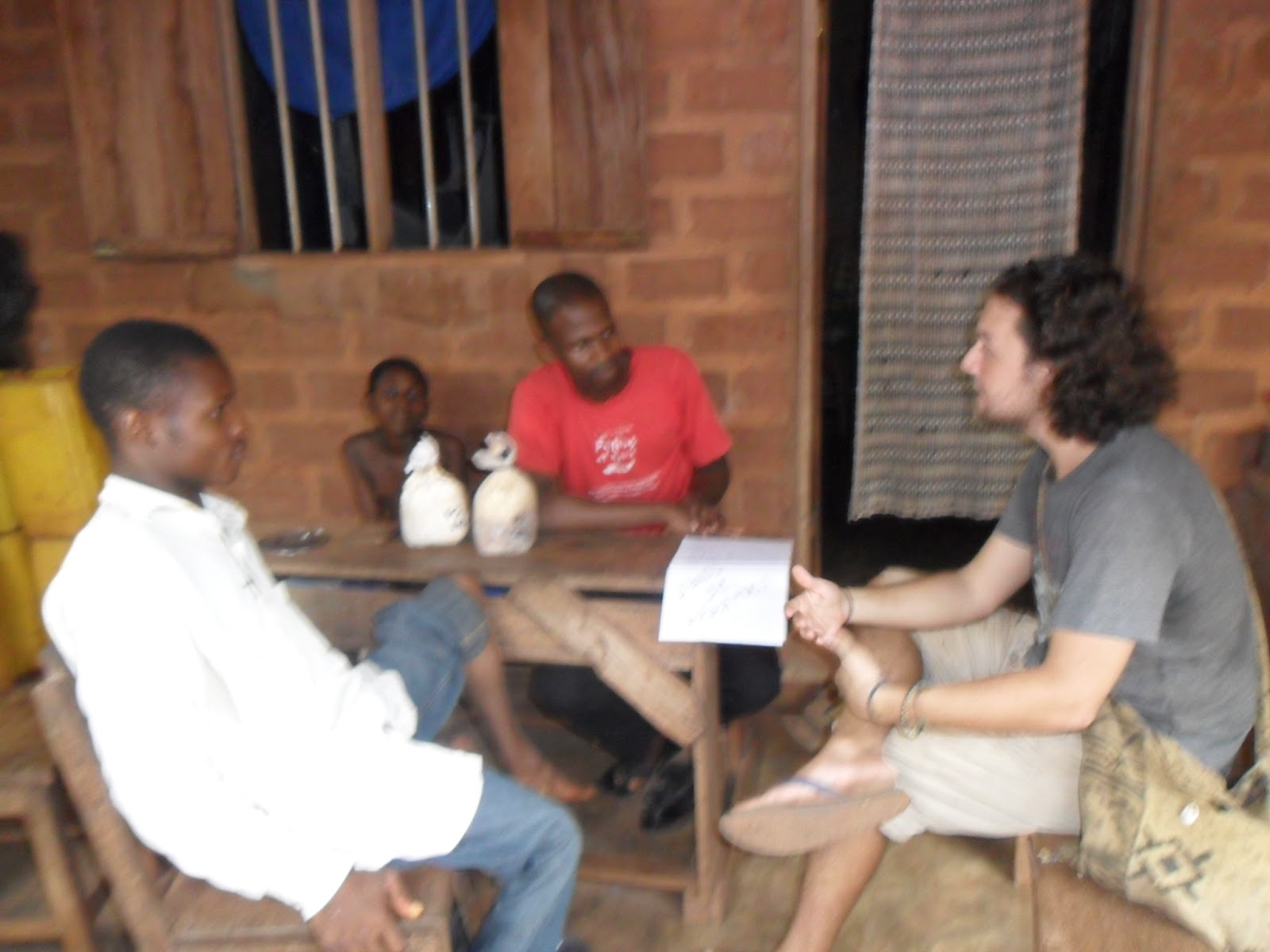
Sky patiently and kindly showed them the three day process of growing mushrooms.  It was doable.  For Sky’s training we used one of the three bags of spores that I had purchased.  In a few weeks, Raoul and Honou would plant the rest of them by themselves.  They became fast friends with Sky.  We walked to Raoul's house so that they could show him their big plans.  They had land nearby where they could grow moringa, and pineapple, and Raoul had already started building crates for elevage.  I told them they needed a name for their business.  They named it ‘Young Men’s Business’.  Not too dramatic, but they were pleased with it, and to them it seemed significant. 


L-R Raoul, Honou, Ackbennie
Ackbennie and her students
During the time we were waiting to plant the other two bags of spores, I took them to Tesvie to meet with Ackbennie (the woman who had helped me buy the supplies,) so that she could show them her shed, and talk to them about the benefits and pitfalls of growing mushrooms.  They loved Ackbennie.  She was a wealth of information for them.  They now had a full circle of information, from Sky who taught them the basics of growing mushrooms to me teaching them bookkeeping and Ackbennie teaching them how to sell them, how much to sell them for, and what they might expect.  After seeing Ackbennie’s shed, Raoul went  home and built his own shed. 

The following weekend they planted the rest of the spores. They have had their first harvest.   They sold every one of them in a few days without hardly even trying.  Seems the people of Tchekpo know about mushrooms, but no one has grown or sold them here before.  They have a waiting list for the next harvest.  Each bag of spores (they have 3) produces about three harvests…So they have enough to see enough profit to be able to invest in their next step.  Step 2 - Moringa!

Sky came back again last week.  He was so impressed with what they had accomplished, and I think was wowed by the shed Raoul had built.  They showed him their bookkeeping ledger from their first harvest, which shows a profit!! He spent a lot of time with them.  They listened intently to everything he had to say.  Sky also brought a sack of moringa seed for them to plant.  Ben,  another volunteer who has a specialty in growing moringa is coming in a few weeks to meet with them.

Raoul and Honou are going to be successful.  They are going to be able to make a living for themselves, and expand their business.  I think Raoul will soon be able to have enough money to go to Ghana and find a doctor who might be able to help him with his headaches.   It was exciting for me, and for Sky.  So many things we attempt, don’t have this good of an outcome for a variety of reasons.  Sky and I both talked about how motivated they were and how gratifying it was to help them.

I’ve told Raoul and Honou often, “ The student becomes the teacher”.  When they move on from mushrooms, they need to share what they've learned and teach others here, how to grow them.  I also want them to teach bookkeeping to the Women’s Groupement Association (75 women who sell their farm products at the local marche)  and at the Lycee (high school.)  They say they will.  I believe they can do anything.  I’m so proud of them.

Raoul, Sky, Raouls father, mother and sister, and Honou
SideNote:  Sky is a really nice looking young man, with thick, brown, long, curly hair.  When we went to Raoul’s house; Raouls mother started laughing and shouting…Jesu Christo…Jesu Christo….for a second she thought that Jesus Christ had come to visit.  We all had a good laugh.  I think there was a little part of them that believed maybe he had.  At any rate I know they felt like their prayers had been answered.

Saturday, December 31, 2011

Shades of Africa


I never imagined I’d be saying, what I’m about to say.  And now it seems ridiculous that I haven't had an awareness of this all along.  I have come to love the colors of Togo!  I’ve spent a lot of my time here thinking how awful and dirty and ugly everything is from a purely aesthetic point of view; and more than once wondered what it would be like for people from my village to wander the streets of Paris or Madrid or walk through Loose Park in Kansas City.  Everything green and lush and orderly and clean.  I showed Leah’s mom photographs of Spain.  I could see that she was stunned by the beauty of it.  She’s barely ever been out of Tchekpo.


It seemed like suddenly I was seeing colors and landscapes that stopped me in my tracks with their unique beauty.  I don’t know if it’s because at this time of the year the colors are more enhanced or if it’s always been this pretty, and I just didn’t see it.  Where once everything seemed just dirty, dark red.  Everything.  Now I see a unique red and different variations of red; a lot of yellow and gold.  Colors that glow in the sunlight and at dusk.  Most people’s huts are made of clay bricks.  I used to find it dismal.  Now I walk down the path and think how beautifullyand naturally  they fit into the landscape. Every now and then someone has painted their house.  There’s a beautiful compound just down the road.  I admire the woman and her son who live there.  They just painted their house the prettiest blue.  It's almost violet and it blends in so beautifully with their clay courtyard and garden.   There is trash and waste scattered everywhere along the way.  But inside the compounds are clean, comfortable and pleasing to the eye.


I’ve caught glimpses of beauty here, but it isn’t easy to see past the squalor in Togo.  Pagne has always captured my attention. It’s always been a pleasant diversion for me. Pagne is the bright colored fabric that is ubiquitous in Africa.   I especially look forward to seeing the kaliedescope of colors and design on the men, women and children for special occasions and for Sunday church service.  If someone hasn’t done a photography book on African Pagne, they should.  There’s nothing more vibrant or more revealing than the world of pagne.  I revel in the variety, the colors, the personality of pagne and those who wear it.  There’s no black or beige or taupe here!  I often spend my time in church examining everyones pagne.   I wonder about the steps each person took to arrive at this creation, this pattern, and design.  Each one so uniquely different, and most are beautifully sewn.  The designs and colors are such an expression of the person, family and occasion.  No one fears going over the top.  No one snickers at the woman whose headscarf is defying gravity and sparkling at the same time.  They embrace this expression of individuality.  Nothing aesthetically defines Africa like pagne.


Doors have also captured my attention over my time here.  I’ve come to realize that doors to compounds are a sort of status symbol.  There are reed doors, and wooden doors, and metal doors.  The metal doors are handworked and their patina changes color over time.  They are made by artisans.  A metal door and a cement compound floor is upper class in Tchekpo.  Most people have reed or wooden doors and dirt floors.  None of the doors could keep even an inexperienced robber out.  Doors are for the most part, decorative and they feign an air of privacy.  A spry child could be hoisted over almost all the doors and/or compound walls. 

Their doors are just another expression of their identity,  as is the pagne they choose or the scarification they have on their body.  This is who I am! 


Colors.   I’m more than a little surprised that my sense of  the beauty that is here took so long to appreciate.  I do long for green fields of grass, big huge Midwest trees, and all the colors and seasons that come with that.  But for now I appreciate more fully the beauty that surrounds me here in Togo.


I often ride in the bush taxi from Tchekpo to Lome seeing the poverty and squalor; the ugliness of it.  The chaos of it.  The grayness of it.  The pollution of it.   But that is on the national road.  Togo can’t be judged by what you see from the bush taxi on the national road. Beyond that, behind the national road where the small to medium size villages are, and in remote areas the colors and shapes become uniquely African and vibrant in their own way.  They become beautiful.  I’m so glad I can see it.

Sunday, October 16, 2011

For Vivianne, Du Courage!


I've been processing the event yesterday.  It was A Community M.A.P. Event and the topic was Empowering Girls and Why Education is Important.  We used literature from Peace Corps Togo M.A.P. Program and from a U.S.Aid Program.  The Tchekpo M.A.P.  Committee did an awesome job.  They did a fantastic job!  I’m really proud of them. 
http://terrynichols.blogspot.com/2010/09/map.html


At times it was little hard to gauge how it was going.  Almost all of it was given in Ewe.  I had one or two people interpret for me from time to time.  It seemed all the points we had wanted to cover were being discussed.  Empowering girls. Talking about the importance of education.  They were asked to think about other things they can do before they have a family.  Talked about condoms, talked about and demonstrated perceived gender roles.  The presenters and topic captured the attention of the audience of primarily young women.  I saw the principal of the highschool and the teachers learn things too, and they would jump up from time to time to speak their mind or emphasize a point.   There was a healthy back and forth participation between the audience and the presenters.  Excellent audience participation, the young women fearlessly asking smart questions.


Huge crowd, about six PCV's came, which was really nice.  The principal of the high school and most of the teachers came.  Lot's and lot's of kids, lots and lots of girls all dressed up in their school uniforms.


There were some glitches, that didn't matter...we should have had a megaphone....


Katanga and Georgette!!
The sketches were great...the kids who performed them were quite professional and prepared...they were loud and faced the audience and had  props and the sketches were very fitting for the topic.   Three women spoke in all.  We chose women who exemplify strength and poise and are a good example that women can do anything, even in Togo...Georgette, one of my community partners and friend was a speaker.  I was really impressed with the content and how she delivered her speech about gender equity.  Next a woman with Borne Fonden (NGO) spoke.  She spoke about the importance of girls staying in school, and then Katanga.  Katanga is a Director for an NGO (not-profit) organization here in Togo.  I had heard her speak at a regional association conference, and she was dynamic.  I tracked her down and asked her if she would be interested in speaking on this topic for our event.  She was great.  She inspired the girls, and I think  the teachers as well.  (The teachers are all male.)  Katanga has a gift!


Vivianne
The jeweled crown of the day, came after I went home, I was resting, doors/windows closed, but someone knocked.  It was Honou Koffi with a girl about his age.  Vivianne.  She was a beautiful girl.  She wanted to thank me for today and she wanted to talk more about opportunitites for girls.  She excels in Physics and math.  I know that Katanga asked the girls how many were interested in science.  What an awesome  question for these young village girls.   Peace Corps has an annual science camp that I'll get Vivianne into, and set her up with a mentor.  You could see something in her face. I don't know what to call it, but It turns out to be just what I was looking for here.... I think it's a look of intelligence and determination. 


Some  girls were inspired.  Some people learned about community organizing, while others
experienced the importance of volunteering.  I'm quite content about it all.  I know this Peace Corps Training and event will have a positive, sustainable impact on many people in different ways.  The organizers and the participants.  This is just what we are supposed to be doing, so..  cool.


For more about M.A.P.:   http://terrynichols.blogspot.com/2011/08/map-tchekpo.html

Thursday, October 13, 2011

Vignettes - Numero Deux

Leah
Leah…my thirteen year old neighbor, friend, helper.  I’ve only been here for a little over a year, but this year has been one of a giant growth spurt for Leah, both physically and emotionally.  I think she’s grown at least 3 or 4 inches.  I remember one of the first times she carried water for me.  She had the bucket on her head, was walking through the compound door, and I could see that she was starting to wobble.  Our eyes met and we both sensed what would happen next, the bucket of water being too heavy for her little self.  She fell over from the weight of the bucket, crashed to the ground, spilling the water.  Dripping wet, she was so, so embarrassed.  I rushed out to her, helped her up, dried off her face.  She was not hurt, but her pride took a hit.  To get her to laugh, I mimicked her wobbling, and I fell down to the ground.  It worked.  She laughed.  We’ve been best friends ever since.  Well except for the many times that she’s mad at me.


 She starts school on Monday.  It will be her first day at the Lycee (high school.)   It is an understatement to say that it is quite an accomplishment to graduate from the primary school to the Lycee, especially for a girl.  There are over 500 students attending the Tchekpo Lycee.  About 15% of that 500 are girls.  Students must study hard in primary school and pass a rigorous three days of tests before they can attend the Lycee.  The day Leah got the certificate for passing the tests she came to my house to show it to me.  She was so proud of herself, and I’m so proud of her.


Leah is a typical thirteen year old girl in almost every way.  She is very moody.  One minute she will be smiling and laughing with me and the next minute she is sulking and refuses to speak.  Luckily I had experience with my own teenage girls.  When she is in one of her “moods” it affects me in the same way it did when my daughters were in one of their moods.  Very exasperating.  But, it does help to know that these are typical manifestations of teenage moodiness.  And just one more proof that we humans have universal emotions.


Yesterday Leah came to my house.  She had been in Taglibo with her grandparents for about a week.  I had seen her just before she left.  She was very excited about going.  She was going to see her father who lives there with his new family.  Leah’s mother and father are divorced.  She told me she was going to see her father and he was going to buy her some school supplies.   She makes the trip there occasionally to see him and to see her grandparents.  She came over several times before she left to tell me how long she would be gone, and to make sure I had enough water until she returned. 


When she showed up at my house upon her return, I could tell something was very wrong.  She came in my house, sat on a chair in the corner, and looked very sad.  “What’s wrong?” I asked.  She didn’t answer, just sat there looking very forlorn.  Finally she told me that her father had not shown up, and she was unable to buy her school supplies.  Because this was Friday afternoon, it would be impossible for her to get the supplies she needed before school starts on Monday.  She was desolate!  Just like any teenage girl would be who did not have what they needed before their first day of high school.  I felt so sorry for her.  I think it was not just the supplies but also the fact that her father had let her down.  It was late Friday afternoon, much too late for me to be able to go to Tesvie or Taglibo to get what she needed.  As a matter of fact I had just returned from Tesvie, where I bought Mahsoblee supplies for her first day of school.  Leah and I just kind of sat and looked at each other.  Tears were running down her face.  Finally I decided I could give her a few things that I had bought Mahsoblee.  This being Mahsoblees first day of school ever, I knew she would not need everything that I bought her.  So we went through Mahsoblee’s things.  I pulled out a bright pink ruler, a couple of pens, an eraser, a notebook, and also the most coveted Lycee tool….a little case that housed a geometry compass and pencils.  I had actually bought the compass as a gift for Moses, because it is his first day at the Lycee also.  I decided Moses would have to wait.  I hated not to have something for Moses, but he wasn’t expecting anything.  I could get him something next week.  Then I went in my bedroom and got a light weight book bag that I rarely use.  We put everything in the bag.  It was all make-shift, but it was enough to get her started.  Her mood lightened.  She was very grateful in her little teenage way.  “Thank you very much.”  she said in English and gave me a rare hug.


A little while later she came over and demonstrated her appreciation.  She washed and scrubbed my porch and the chairs on my porch and my screen door.  I heard her singing and laughing.  I told her I was going to take her picture the Monday morning when she goes off to school.  She beamed.


Milestone for Mahsoblee
Mahsoblee is six years old, or so her gramma thinks.  Most kids in Togo start school at age 4 or 5.  Mahsoblee didn’t go to school until now because of her health.  She was too sick, too fragile to attend. 


If you’ve read some or all of my posts about Mahsoblee’s journey, you will know that it has been quite a challenge.  My goal was to get her well, and then help educate her gramma on how to maintain her health.  Mahsoblee has sickle cell anemia.  It is a lifelong chronic illness, with the age of 30 being the life expectancy here in Togo for those who have sickle cell.  Many, many die before they reach five years of age.  All suffer with daily pain.  Sickle Cell is difficult to maintain in the United States.  It is a monumental effort to maintain in Togo.  Medicine, nutrition, water, malaria prevention….


Since July she has endured two blood transplants, twenty days in three different hospitals, pin pricks, IV’s, and a myriad of consultations from doctors and surgeons, poking and prodding her tiny body.   Until at the end we were armed with information, knowledge and a plan that we could only hope will help maintain her health and keep her disease at bay.   She will continue to go to the Kouve Hospital once a month for doctors consultation and for laboratory tests.  When I leave in August 2012, I have recruited the nuns from the Kouve Hospital and a person here in Tchekpo to help Mahsoblees gramma maintain Mahsoblees health, education and well being.


The last doctor we saw in Lome was Dr. Wossonou.  He is a pediatrician specialist.  He explained to us the challenges Mahsoblee has in front of her.  He also emphasized the degree of pain that she endures every day.  I asked him if she could start school.  He said that she could and she should start school, but that Director and her teachers should be aware of her illness.  I was excited about this news.  All last year I would see Mahsoblee sitting on the stoop in front of my house when the kids were going and coming from school.  I wanted her to be able to go.  She’s a very, very smart little girl. 


Touissaint and Mahsoblee
We used some of the donated money to have a school uniform made for her, and to buy her some school supplies and a book bag.  Each day for five days before school started I gave her some little thing for school.  The day before school I gave her, her uniform and her brand new book bag.  She was very happy, very excited, and I think she could not imagine what this new adventure would be like.


The first day of school arrived.  She came by my house early in the morning dressed in her uniform with her bright pink book bag.  She looked scared, apprehensive and happy.    She and Toussaint waited patiently by the water pump for the school bell to ring.  I watched as she ran off with all the other children, to her very first day of school.  She doesn’t have to sit on the stoop this year and watch everyone else pass her by.


Ohhhh Yo-Vo I love You!
Tchekpo is located smack in the middle of Tesvie to the west and Taglibo to the east.  About thirty miles in each direction of the most notoriously bad road in Togo.  Full of ruts and holes.  Vehicles cross several bridges between Tesvie and Tchekpo.  I have seen, on more than several occasions,  trucks and bush taxi’s that have gone off the bridge or the road…..mangled messes of twisted iron.   One time there was a large semi truck precariously and dangerously hanging half over the bridge guardrail, wheels spinning, engine spewing smoke.  That day I had to get out of the bush taxi I was riding in and walk the two miles back to Tchekpo.   I walked with maybe 30 to 50 other people who had also gotten out of their bush taxis because the vehicles they had been riding in were also unable to pass.   But the Togolese always seem to make the best of every situation.  On the walk people were singing, and laughing and dancing.  The road was shut down for several days, with semi’s and work trucks backed up for miles. 


Almost every day when you travel this road you see a team of two or three men or young boys, filling the pot holes and ruts with dirt.   This temporary fix lasts only a few days, until the dirt is gone and the rutt  reappears.  These crews of men are sweating, shirtless, shoeless with only their hoes; digging dirt, filling the holes. They stand and bend and kneel in the middle of the road without any shelter from the blazing sun and heat.  Their bodies and muscles glistening from the sun and the sweat.  This is their job from dawn to dusk.  These men only hope that the cars and trucks and moto’s  will throw some change to the ground as they pass.  There are no guarantees, no promises of being paid for their back breaking work. 


 There are usually four or five men or boys working  together at various places along the road.  They will make a vine and stretch it across the road.  As vehicles approach they raise the vine as if this will block the vehicles from passing.  However…always, always they drop the vine the second before the vehicle gets to it.  Much more often than not the driver will make a motion with his hand, as if saying…I’ll catch you on the way back.  Unfortunately, only very occasionally do I see a driver toss some coins…..I always turn around to catch a glimpse of the workers whether coins have been tossed or not.  When they have been tossed I see the boys whooping and hollering, laughing and jumping and waving their hands.  When coins have not been tossed I see the same thing.  It’s remarkable I think that they seem surprisingly unresentful when no coins are tossed.   It’s hard, hard work, and really very helpful to drivers of the road.   It’s a job of chance.  No one has promised them anything.  They don’t expect anything.  They only hope their efforts are recognized and rewarded.


I now always try to remember to have a few coins ready to toss.  I’ve never seen passengers toss coins,  but why not??!!??  My ride is easier because of what they do.  I have one less bounce, one less knock in the head from  the taxi hitting a rutt.  And besides, I absolutely love to see the look of surprise, and then delight on their faces when a yo-vo (white person) has tossed some coins.  They know, and I know that their hard work is appreciated.


One very hot day the taxi I was in approached a road crew.  They had their vine stretched across the road.  It was a group of teenage boys.  It was obvious they had been working very hard.  I had seen holes filled for the previous  few miles.  They held up the vine as the taxi approached.  The driver slowed down and then waved to them that he would catch them next time.  Aha!  I had my coins ready.  The driver saw me reaching for them and he slowed down, smiling.  I tossed the coins out the window.  One of the teenage boys…jumped, and hollered…He came over to my window smiling ear to ear.  He said Ohhhhh yo-vo…..I love you (he did! He said that in English!)….then to my surprise he reached his hands inside the window took my face in his hands and playfully gave me a kiss on the cheek..  All of this happened in a micro second, as the taxi slowed down.  The taxi driver was laughing too as he picked up speed.  I turned around for one last look, and the boy was  still jumping up and down, waving his arms.  “Bon Travaile,” I shouted, laughing. (Good Work!) 


I has wished that I had my camera handy to capture the moment, but the memory is forever etched in my mind. 


Sixth Sense
I suppose the weather here is similar to any tropical climate.  Storms form and swoop in, in an instant, with downpours that seem like they will never cease, flooding the roads with rivers of rapidly flowing, muddy water.  And then the storm is over as quickly as it began.  The rivers of rain dried up within a few hours.  More days than not during the rainy season, I ask not one, but two or three neighbors, “Is it going to rain today?”  I just like to know before I set out if I should take an umbrella. And I like to ask more than one person because #1, I still never believe them, and #2 I want to see if they ALL have this sixth sense. They ALWAYS know.  I’ve never yet, seen them be wrong.  It’s an amazing feat, because many times clouds are rolling in, it’s thundering and I would bet my last dollar that it will indeed rain.  Most of the time, when I ask, they don’t even look up at the sky, they just say yes or no.  Sometimes, though, they do look at the sky,  I guess having not thought about it before I asked.  One of my favorite neighbors Koku, I think has tired of me asking.  He probably wonders how I wouldn’t know this, but he patiently if not condescendingly answers me, none-the-less.


Last week a storm rolled in just before daybreak.  I was sitting at my computer drinking my first cup of coffee listening to and enjoying the cool thunderous storm.  Suddenly I heard the loudest crash I’ve ever heard here.  It startled me, and made me jump.  I couldn’t imagine what in the world it was.  I ran to my window, and there in front of me was a paillot (overhang) that had crashed to the ground from the weight of the pouring rain. 


Yesterday, I was on my way to a Tom-Tom dance.  It surely looked like rain.  I was quite sure it would rain any minute.  I didn’t know whether or not to go because everything is just immediately cancelled when it rains.  I asked Koku, “Is it going to rain?”  He looked up at the sky, and said, no, no, no rain today.  Impossible I thought.  This will be the day that their powers are proven fallible.  But I went on my way, and by god, it didn’t rain, and I enjoyed the party.


Today, Leah was going to wash my clothes, but it looks like rain.  Rain never impedes them from doing their laundry.  They could care less if just as they get their clothes hung on the line it rains.  But, I’m a bit more prissy, and if it’s going to rain, I’d prefer to wait so that it won’t take days for my clothes to dry.  “Leah, is it going to rain today?” I asked before she got started.  “No, no,” she said.  “No rain today.”  She washed my clothes this morning, and so far, she’s right…but it sure looks like it will.


Maybe all or many farmers back home have this instinct, but I don’t think they would be so absolutely positive as the people I ask here.   Oh! If the meteorologists in the U.S. had this ability!!

A L’occasion des ceremonies de ses Jumelles

I just returned from a classic Voodoo ceremony.  It was a celebration in honor of Monsieur and Madame Touglo’s twin girls.  The girls are about six.  I would say this voodoo celebration is something like a baptism or Jewish Bat Mitzvah.  That being a very loose comparison, meaning it is a celebration of a turning point in a child’s life, and in this case an official voodoo initiation of being twins.  And so this day was to recognize and celebrate the gift of the Twins, and to thank the spirits for this blessing.


Monsieur Touglo teaches at L’ecole No. 5, a primary school.  Mr. Touglo is one of my favorites.  He’s always happy, and polite, and I know he’s very smart.  I was pleased that I was invited to this important occasion.  Monsieur Dove and Kaizai came by my house earlier in the week with a handwritten invitation to Monsieur Touglo’s Fete’.  They told me they would come to my house at 7am on Friday and walk with me to the event….and so they did.


The Ceremony
It was fascinating…..full of rituals, both African and Voodoo.  It’s a natural manifestation of the Voodoo philosophy that twins would be considered special.  Twins are viewed as two halves of one soul.  They are given status and looked on as having special powers.  Twins never die in the Voodoo Culture, they live on to be spiritual guides for the generations to come.  Mr. Touglo has three daughters.  Following folklore the child that comes after the twins is even MORE special because that child will benefit from the personal guidance of the Twins. 


There were many people; neighbors, extended family and some dignitaries and while the Chief couldn’t come, there were representatives of the Chief present.  The ritual began with the family (mom, dad and the three children) sitting in the middle of a circle of probably over 100 guests.  During this time they were presented with many beautiful necklaces and other jewelry,  all of which were  ceremoniously placed on each of them.   Earrings, necklaces, bracelets.  Drums beating in the background.  Then the girls, all three of them, were taken aside, away from their parents  and eye makeup was applied to each one of them by a voodoo priestess.   I didn’t understand this part, but later someone told me it is part of the voodoo ceremony.  The eye makeup represents keeping bad spirits from entering through their eyes.  I’m sure there’s probably a little more to that, but I was kind of glad to hear this interpretation.


The ceremony was very serious during the presentation of the jewelry, but the rest of the time it seemed to be  lighthearted, like a party after a First Communion.  The guests, mingled, drank and ate, listened to music.  All three of the girls seemed to enjoy themselves.  They were serious and well behaved when they needed to be and then they were playful when left to their own devices.   I could see that the whole family was very proud of this event.   I think maybe they were a little nervous also.  It was a “big to-do,” for a little village family.


I learn more about voodoo as I go along.  There are so many misperceptions.  From what I’ve learned thus far, it is really a wonderful, quite beautiful philosophy, though sometimes quite complicated, for this western thinker.  It’s difficult to find accurate, indepth information about voodoo, primarily because one of Voodoo’s tenets is that it is an “oral” history.  The tenets and traditions of this religion have been passed on orally from generation to the next for over 6000 years.  It has also gone through a variety of manifestations as people migrated around the world.  The basic tenets of voodoo are the same everywhere, if not all the details.


The Essence of Voodoo
“Within the voodoo society, there are no accidents. Practitioners believe that nothing and no event has a life of its own. That is why "vous deux", you two, you too. The universe is all one. Each thing affects something else. Scientists know that. Nature knows it. Many spiritualists agree that we are not separate, we all serve as parts of One.  So, in essence, what you do unto another, you do unto you, because you ARE the other. Voo doo. View you. We are mirrors of each others souls. God is manifest through the spirits of ancestors who can bring good or harm and must be honored in ceremonies. There is a sacred cycle between the living and the dead. Believers ask for their misery to end. Rituals include prayers, drumming, dancing, singing and animal sacrifice.


Some people associate Voodoo with evil, but many of its rituals, even those that include the sacrifice of live animals, focus on respect and peace. Its religious leaders become community leaders, providing guidance and settling disputes. Leaders also frequently provide medical care in the form of folk medicine. Priests, priestesses and other practitioners typically dedicate their work to helping and caring for others “    http://news.nationalgeographic.com/news/2004/02/0211_040211_twincult.html


Ablo (A traditional Togo Meal)
The “After Party”
I had to leave the ceremony for a meeting after about three hours, but I got to see the ceremony.  Dove and Kaizai were demonstratively disappointed that I had to leave so soon.  On the way to the event they seemed upset when I told them what time I’d have to leave.   When I left  I’m sure the festivities were barely started and that this party would go into the night if not the next day. 


Kazai and His Father
Dove and Kaizai had other plans for me.  I almost foiled them.  I couldn’t understand what they had in mind as we were walking.  I thought I was going home to get ready to go to a meeting in Taglibo…..but I  could tell that they had something else in mind.  After a short walk we reached Kaizai’s house.  I had never been to his home before.  His entire family was there…his wife, his father, his brothers, children.  I don’t think they were there because of me, though they were really welcoming.  I think this whole family shares this compound and the ones next door, and this get together is somewhat of a daily occurrence. They were all busy doing something.   Kaizai’s wife was cooking, his mother was holding her grandbaby.  Kaizai’s brothers wife was sewing, Kaizai’s father was sitting in a doorway on the stoop, shucking corn.  Little kids were running about.  


The Girls
The Boys
It was really nice to meet Kaizai’s family. I loved his family.   They asked me to take photo’s.  After a short while meeting and greeting everyone Dove and Kaizai led me across the road to his brothers house.  His brother and his wife had a meal prepared for me, a very traditional African meal.  Ablo.  It’s made of cornmeal, and there is a spicy sauce that goes over it, and usually chicken.  I really, really like ablo.  It’s kinda got the taste, if not the consistency, of cornbread with a spicy sauce.  They had a little table set up, just for me and brought me a couple courses of food.  I think they were very pleased to have me as a guest in their house, and they were thanking me, and getting to know me.  We joked a bit about the fact that I don’t eat meat.  That’s a little shocking to them and hard for them to understand.  It gets about the same reaction as when you say, “I’m divorced.”  They talked to me while I ate, I kept asking them to join me, but that’s not the normal tradition. 


They didn’t keep me long.  They knew that I was pressed for time.  I appreciated that I got to go to Kazai’s.  It’s obvious they were planning on having me there for a meal.   After I ate I said good bye to everyone, and thanked them.

 
It was such a nice day.


I had a lot to think about on my walk home.